
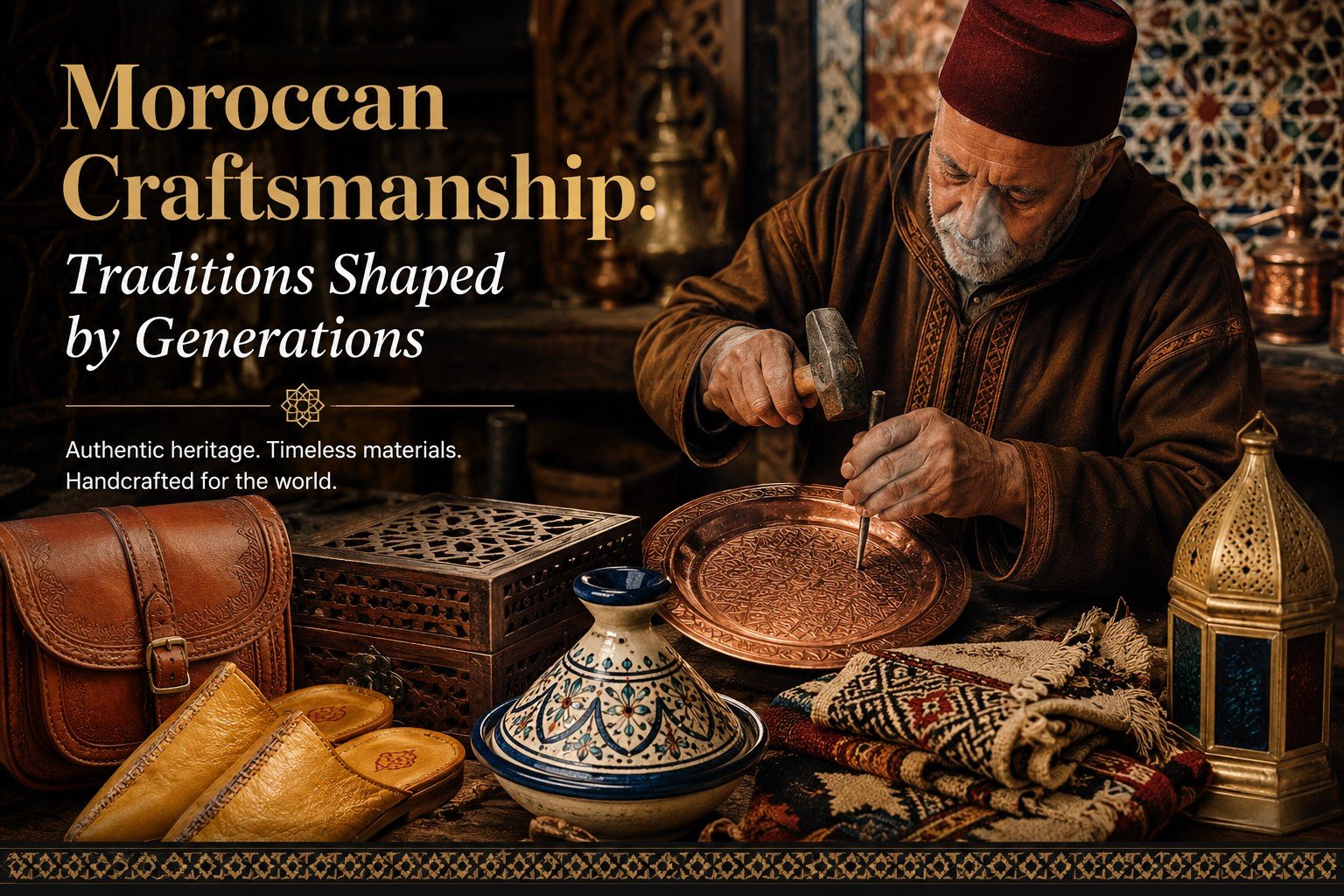
Moroccan craftsmanship is more than a collection of beautiful handmade objects. It is a living heritage shaped by generations of artisans, regional traditions, local materials, and skills passed from one hand to another.
From the leather workshops of Fez to the pottery traditions of Safi and the woodworking heritage of Essaouira, Morocco has developed a remarkably diverse craft culture. Each region has contributed its own techniques, patterns, materials, and artistic identity.
Today, these traditions continue to evolve. Moroccan artisans preserve centuries-old knowledge while creating objects that find their place in contemporary homes around the world.
What Makes Moroccan Craftsmanship Unique?
Moroccan craftsmanship is deeply connected to everyday life. Historically, artisans did not simply produce decorative pieces. They created objects intended to be used: ceramics for serving food, leather goods for carrying personal belongings, woven textiles for warmth and decoration, wooden boxes for storage, and metalwork for the home.
This relationship between beauty and function remains one of the defining characteristics of Moroccan crafts.
Another distinctive feature is diversity. Morocco sits at the crossroads of Africa, the Mediterranean, the Atlantic and the wider Arab and Amazigh cultural worlds. Over centuries, different influences interacted with local traditions and contributed to the country’s rich visual language.
Geometric patterns, floral motifs, carved wood, colorful ceramics, woven textiles and detailed metalwork can therefore vary considerably from one region to another.
Fez: A Historic Center of Moroccan Craftsmanship
Few Moroccan cities are as closely associated with traditional craftsmanship as Fez.
Its historic medina has been home to generations of artisans specializing in leather, metalwork, ceramics, wood and other crafts.
Moroccan Leather
Leather craftsmanship is particularly associated with Fez.
Traditional tanneries are among the city’s most recognizable craft sites. Hides are processed and prepared before being transformed by skilled artisans into finished products.
Leatherworkers then use the material to create items such as:
- Bags and satchels
- Wallets and card holders
- Belts
- Slippers
- Poufs
- Small accessories
The value of a handmade Moroccan leather object is not simply in the material itself. Cutting, stitching, finishing and assembling the piece all require skill and experience.
Small variations between handmade pieces are therefore natural and can form part of their individual character.
Safi and the Tradition of Moroccan Pottery
On Morocco’s Atlantic coast, Safi has developed a strong reputation for pottery and ceramics.
Clay is shaped into plates, bowls, vases, tagines and decorative pieces before being dried, decorated and fired.
Moroccan pottery is especially recognizable for its use of geometric and floral patterns. Depending on the artisan and region, designs can range from highly detailed compositions to much simpler contemporary forms.
Creating a ceramic piece involves several stages.
The clay must first be prepared and shaped. After drying, the object can be decorated and glazed before being fired at high temperatures.
The result combines practical function with artistic expression.
A handmade Moroccan bowl, for example, can serve as an everyday household object while simultaneously carrying patterns and techniques connected to a much older craft tradition.
Marrakech: The Art of the Souk
Marrakech offers another expression of Moroccan craftsmanship.
Walking through its traditional souks reveals workshops and stalls filled with metal lanterns, trays, leather goods, textiles, wooden objects, baskets and decorative pieces.
Metalwork is particularly visible.
Artisans work with materials such as brass and copper to produce trays, lanterns, mirrors and decorative objects. Surfaces may be hammered, engraved or pierced by hand to create intricate patterns.
Moroccan lanterns demonstrate this craftsmanship particularly well.
When light passes through their perforated surfaces, the patterns of the object become patterns of light and shadow. A functional object becomes part of the atmosphere of a room.
Essaouira and Thuya Wood
The coastal city of Essaouira is closely connected with another distinctive Moroccan material: thuya wood.
Artisans have traditionally used this aromatic wood to create boxes, trays, furniture and decorative objects.
Woodworking requires precision. Pieces must be carefully cut, shaped, polished and assembled.
Some objects incorporate decorative inlay techniques using contrasting materials to create geometric compositions across the surface.
The natural grain of the wood is often allowed to remain visible, meaning that even objects created according to the same design can have subtle differences.
This individuality is one of the qualities that distinguishes handmade craftsmanship from standardized industrial production.
Moroccan Textiles and Weaving Traditions
Textile craftsmanship occupies an important place within Moroccan heritage.
Across different regions, weaving traditions have developed around locally available materials and community practices. Rugs, blankets, cushions and other textiles can communicate identity through their patterns, colors and construction.
Many Moroccan rugs are traditionally woven by Amazigh communities.
Their designs vary considerably according to region and weaving tradition. Some use strong geometric compositions and contrasting colors, while others favor more restrained patterns and natural wool tones.
Producing a handwoven textile requires patience.
Individual threads gradually become a complete surface through repeated movements performed by the weaver. Large pieces can represent many hours of work.
This slow process gives handmade textiles a character that mass-produced alternatives cannot reproduce exactly.
Copper, Brass and Traditional Metalwork
Metalworking has long been another important Moroccan craft.
Copper and brass can be shaped into practical and decorative objects including:
- Serving trays
- Bowls
- Lanterns
- Mirrors
- Boxes
- Decorative accessories
- Jewelry
Depending on the object, an artisan may hammer, engrave, cut or polish the metal.
Detailed pieces can require numerous individual operations before they are complete.
Metal also changes with time. Copper and brass can gradually develop a natural patina, giving older objects a different appearance from newly finished pieces.
For many people, this aging process adds character rather than diminishing the object.
The Importance of the Artisan
Behind every authentic handmade object is a person who understands the material.
This human element is fundamental to Moroccan craftsmanship.
Craft knowledge has traditionally been transmitted through practice. An experienced artisan teaches techniques to younger craftspeople, who learn through observation, repetition and direct work with the material.
Mastering a craft can take years.
The artisan needs to understand not only how to reproduce a particular shape but also how different materials behave.
Leather stretches. Wood has grain. Clay responds to moisture and heat. Metal reacts differently depending on thickness and technique.
Experience teaches the craftsperson how to work with these characteristics rather than against them.
Handmade Is Not the Same as Perfectly Identical
Modern manufacturing has conditioned consumers to expect every object to look exactly like the next one.
Handmade craftsmanship works differently.
Two bowls painted by hand may contain slight differences in their patterns. Two leather wallets may show different natural markings. The grain of one wooden box will never be identical to another.
These variations should not automatically be considered defects.
They can be evidence of the materials and processes involved in creating the object.
This is part of the appeal of choosing genuine handmade products: each piece carries subtle characteristics of its own.
Moroccan Craftsmanship in Contemporary Homes
Traditional craftsmanship does not have to remain confined to traditional interiors.
Moroccan objects increasingly work alongside contemporary design.
A hand-hammered brass tray can sit on a minimalist table. A Moroccan ceramic bowl can add pattern to a modern kitchen. A handmade leather accessory can combine traditional skills with a contemporary shape.
This adaptability helps keep craft traditions relevant.
Preserving craftsmanship does not necessarily mean preventing it from changing. Artisans have always responded to new materials, customers and uses.
The challenge is to allow design to evolve without losing the knowledge and human skill behind the object.
Why Supporting Traditional Craftsmanship Matters
Choosing handmade products can have an impact beyond decoration.
Traditional craft industries provide economic opportunities for artisans, workshops, families and local communities. Demand for genuine craftsmanship also creates a reason for younger generations to continue learning specialized skills.
Without a viable market, some techniques risk gradually disappearing.
Supporting craftsmanship therefore contributes to preserving knowledge as well as objects.
It helps maintain the relationship between artisan, material, region and tradition.
How to Choose Authentic Moroccan Handicrafts
When purchasing Moroccan crafts, look beyond appearance alone.
Consider the material used, where the object was produced, how it was made and whether information about its craftsmanship is available.
Signs worth looking for include:
- Natural materials
- Visible handmade details
- Information about origin
- Traditional or clearly explained production techniques
- Natural variations between individual pieces
- Transparent descriptions of materials and construction
Price can also provide context.
Handmade production requires time, materials and skilled labor. Extremely low prices can sometimes indicate industrial production rather than traditional craftsmanship.
The goal is not necessarily to find an object without imperfections. It is to understand who made it, how it was made and what tradition stands behind it.
A Living Moroccan Heritage
Moroccan craftsmanship has survived because it has never been completely static.
Every generation inherits techniques from the previous one, practices them, adapts them and eventually passes them forward.
That continuous transmission connects today’s leatherworkers, potters, weavers, woodworkers and metalworkers with a much longer history.
When we choose a handmade Moroccan object, we are therefore choosing more than its shape or color.
We are encountering a small part of a living tradition — one shaped by materials, places, skilled hands and generations of accumulated knowledge.
That is what makes Moroccan craftsmanship distinctive.
It is not simply something preserved from the past.
It is heritage that continues to be made.